
What Is Feng Shui?
The Dialogue Between People and Place
We spend our lives surrounded by spaces. We wake up in them, move through them, work in them, rest in them, and return to them. Our environments influence how we feel and how we experience our lives, often in ways we don't consciously notice.
You know when you walk into a space and something feels right. It might feel calm, open, welcoming, grounded, or alive.
And sometimes the opposite is true. A room can feel heavy, restless, crowded, or difficult to settle into.
Feng shui gives us a lens to examine and understand our relationship with the environments around us.
The words feng shui translate as “wind and water,” reflecting the movement of the natural world. The practice developed from observing nature and the relationship between people, landscape, and the places they inhabit.
A Living Tradition
Feng shui has a long history rooted in the observation of nature, patterns of change, and the relationship between people and their environments.
One of its foundational texts is the I Ching, or Book of Changes, an ancient Chinese text exploring the patterns of nature, change, and human experience. Its philosophy of change and relationship has deeply influenced the development of feng shui.
Over centuries, different schools and approaches developed within this larger tradition. Form School, one of the oldest documented traditions, focuses on the physical environment, including landscape, landforms, architecture, structures, and the movement of qi through a place. Compass School developed alongside it, incorporating direction, orientation, time, astrological information, and more complex systems of calculation.
Feng shui also evolved through exchanges between Chinese and Tibetan traditions. Black Sect Tantric Buddhist Feng Shui, associated with Tibetan Buddhist and Bon influences alongside Chinese philosophy and feng shui, became an important part of the modern transmission of feng shui to the West, particularly through the teachings of Grandmaster Thomas Lin Yun beginning in the 1970s.
Nama Spaces is rooted in Essential Feng Shui® from the Western School of Feng Shui, developed by Terah Kathryn Collins and grounded in the principles of Form School. The practice honors the Eastern heritage of feng shui while bringing its principles into contemporary Western life.
The Foundations
There are several core concepts that form the foundation for how we read and work with space.
Qi

Qi (pronounced chee) is the vital life energy understood in feng shui to move through people, places, and the natural world. It is dynamic, continually moving, gathering, dispersing, and changing.
We experience qi through the way a place feels and through the way we move through it. Architecture, pathways, doors, windows, stairs, furniture, and the surrounding landscape all influence its movement and quality.
Qi can flow, gather, and settle, or it can move in ways that feel disruptive. Rushing qi moves too quickly, as it can along a long hallway or staircase. Escaping qi disperses before it can gather, as it can through expansive windows, large openings, or a direct alignment between doors. Stagnant qi becomes stuck where pathways are blocked, corners are neglected, or spaces are cluttered and unused. Cutting qi can be created by sharp corners or pointed forms directed toward where we sit or sleep. Oppressive qi can occur beneath heavy beams, low ceilings, or other structures that create a sense of pressure overhead.
The goal is to create a quality of qi that feels balanced, supportive, and appropriate to the space and how it is used.
Yin & Yang
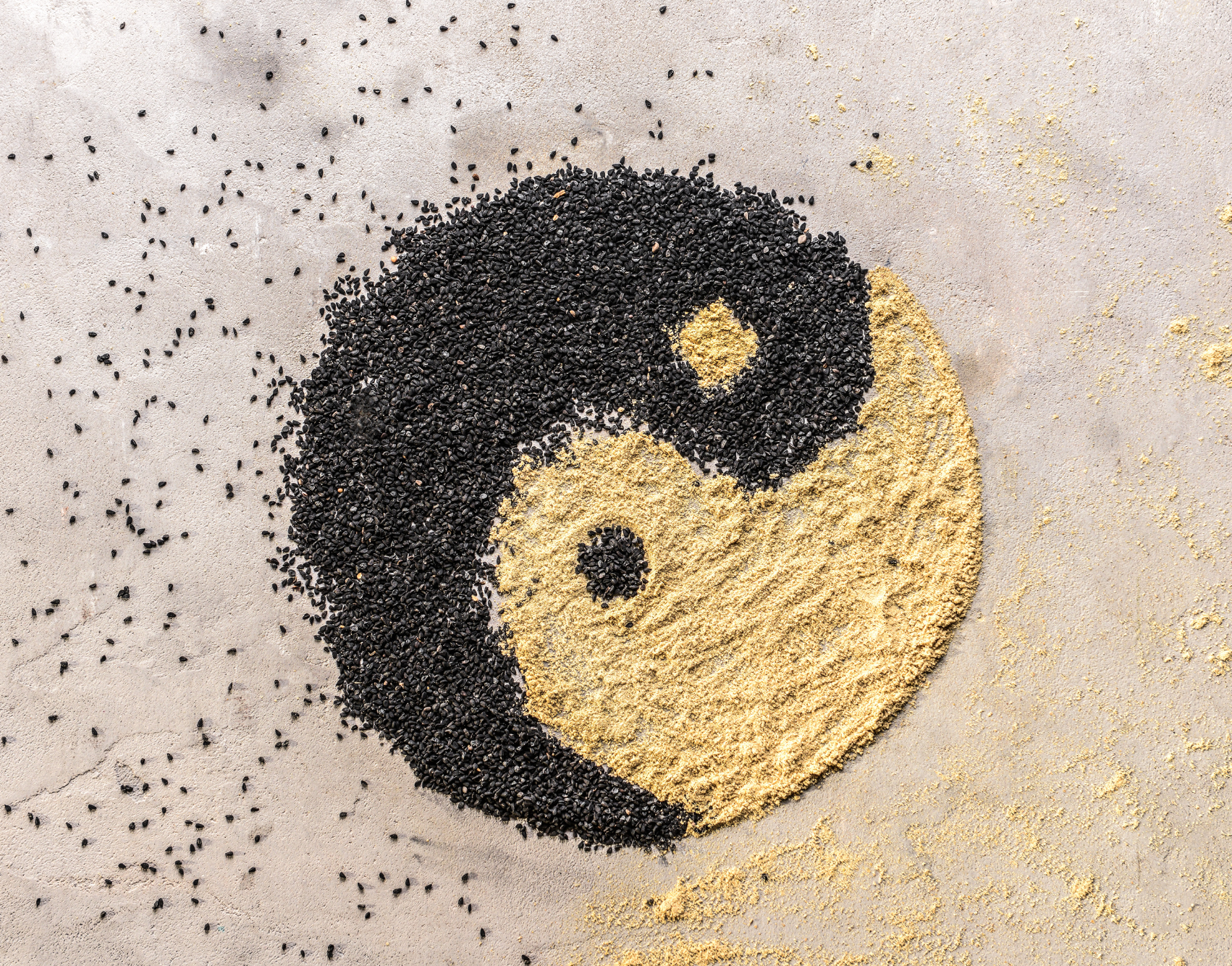
Yin and yang describe complementary qualities found throughout nature and our environments. They help us understand the different qualities present in a space and the relationship between them.
Yin and yang are relative rather than fixed. A bedroom may be more yin than a kitchen, while a sunny terrace may be more yang than a shaded garden. Neither is inherently better than the other, and balance does not mean an equal amount of each. Different spaces require different qualities.
Yang is associated with:
Light and brightness
Warmth
Movement and activity
Sound
Openness and expansion
Clean, simple spaces
Hard, smooth, or reflective surfaces
Height and upward movement
Outward expression
Yin is associated with:
Darkness and softness
Coolness
Stillness and rest
Quiet
Enclosure and containment
Detailed, layered, or intricate spaces
Soft, textured, or yielding surfaces
Low or grounded forms
Inward reflection
Too much yin can make a space feel heavy, dark, withdrawn, or stagnant. Too much yang can make it feel restless, exposed, noisy, or overstimulating. The aim is to create a relationship between yin and yang that supports how a space is meant to be used.
Yin and yang are also constantly changing. Day becomes night, activity becomes rest, and the qualities of a space shift with light, time, season, and use.
In the I Ching, yin and yang are represented by broken and unbroken lines. Their combinations form the Eight Trigrams and the 64 hexagrams, providing a language for understanding patterns of change that also underlies the Bagua.
The Bagua
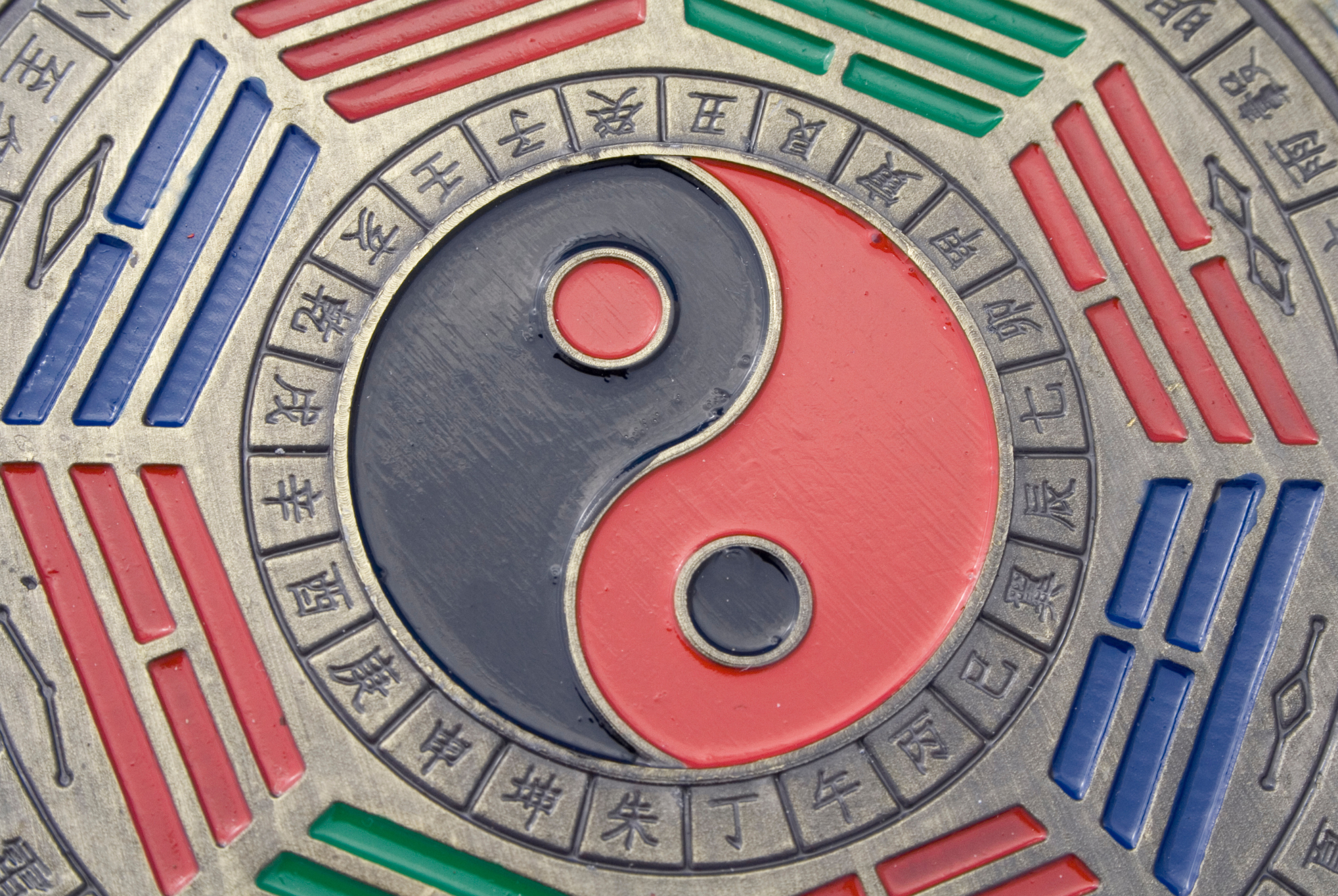
The Bagua is a map used to explore the relationship between our physical environment and different areas of life.
The Bagua is based on the Eight Trigrams of the I Ching, each representing a fundamental quality and pattern found in nature. These eight qualities become a map that can be placed over a space, creating a framework for understanding how different areas of our environment relate to different areas of life.
Because qi enters through the threshold, the front door is where we anchor the Bagua.
Read: The Bagua: A Map for Seeing Your Life Through Space
The Five Elements
The Five Elements, Wood, Fire, Earth, Metal, and Water, are central to feng shui and part of a larger system of correspondences found throughout Chinese philosophy and traditional Chinese medicine.
Each Element expresses a distinct quality of energy and is connected to an extensive network of relationships: colors, shapes, seasons, directions, senses, emotions, and organs of the body, among others.
These correspondences give us a richer way to understand a space: how its qualities affect us, how we express ourselves through our environments, and how different qualities relate to one another.
Read: Introducing the Five Elements
Read: The Five Elements in Balance
Read: The Five Elements in You
Three Fundamental Truths
The foundations of feng shui rest on three fundamental truths: everything is alive, everything is always changing, and everything is connected.
Everything is alive.
Everything contains qi, or living energy, and has a presence and quality of its own. This includes people and nature, but also buildings, rooms, furniture, objects, and the land itself.
The things we live with carry memories, associations, and meaning. Our surroundings affect how we experience ourselves and the lives we are living.
Everything is always changing.
Energy is dynamic, and so is life.
We change. Our relationships change. Our work changes. Our needs change. The seasons change. Our spaces change with us.
A home that supported one chapter of life may need to evolve as we enter another. Feng shui gives us a way to recognize and work with that movement.
Everything is connected.
Nothing exists in isolation. Energy moves between people, places, objects, and the natural world. We are connected to our homes, our communities, and the environments we inhabit.
Within a home, each room also has a relationship to the others. What happens in one part of a space can influence the experience of the whole.
Our environment and our inner world are always in conversation.
Together, these foundations give us a way to read space more consciously and understand how our environments influence the way we live.